Friday, April 3, 2026
Good Friday
Text: John 19:28-30
Sermon Audio
Grace, mercy, and peace from God our Father and our Lord and Savior, Jesus Christ.
You cannot observe Good Friday without talking about crosses, crucifixion, and death, but as much as this becomes normal operating procedure, maybe we need to address some concerns. Of all the ways for Jesus to die, why crucifixion?
First, A. Crucifixion is too Roman. Even if the Romans didn’t invent crucifixion, they certainly perfected it. Decades after Jesus’ death, Jewish historian Josephus records that when the Romans invaded Jerusalem, they crucified five hundred Jews a day, so many people that the Romans started running out of wood to fashion crosses!
This kind of death doesn’t belong among God’s people. It’s out of place. Why not die on the battlefield like righteous King Josiah? Why not die by having stones thrown at you until you die? Righteous Naboth was stoned to death because he refused to give his vineyard to the king. Stephen was the first Christian martyr who died by stoning. What about beheading? That’s what happened to John the Baptist.
Crucifixion is too Roman. Why kill God’s own Son by foreigners in a foreign manner?
Second, B. I won’t want to see, hear of, or imagine crucifixion, it’s too ugly. Ancient Roman author Seneca the younger writes of crucifixion, “Is there such a thing as a person who would actually prefer wasting away in pain on a cross—dying limb by limb one drop of blood at a time—rather than dying quickly? Would any human being willingly choose to be fastened to that cursed tree, especially after the beating that left him deathly weak, deformed, swelling with vicious welts on shoulders and chest, and struggling to draw every last, agonizing breath? Anyone facing such a death would plead to die rather than mount the cross.”
We don’t get the full force of how gruesome this death was. John simply mentions, “Then Pilate took Jesus and flogged him.” John states as a matter of fact, “There they crucified him, and with him two others, one on either side, and Jesus between them.” We don’t want to think of the blood. We don’t want to think of the raw skin. We don’t want to think of the pain.
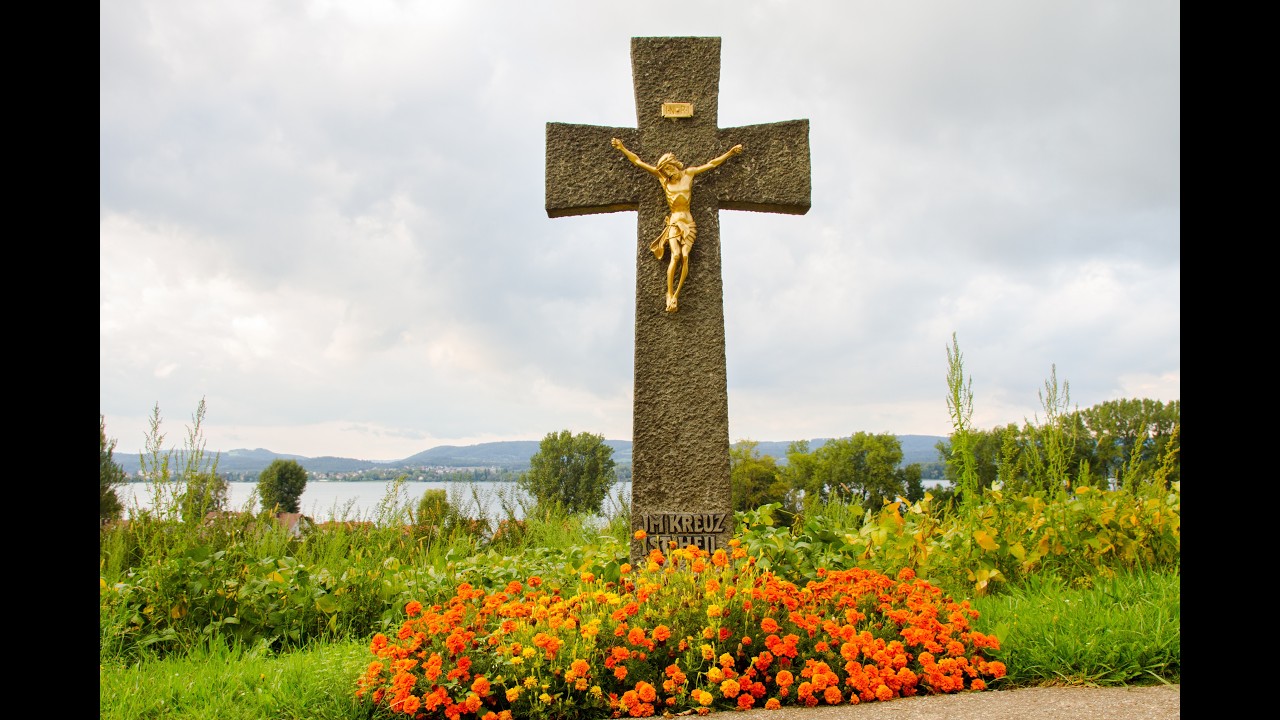
We enjoy bratwurst, but we don’t want to think about how the sausage gets made. Perhaps we can look at a bare cross, and use our imagination, but it’s an ugly, shameful thing to see an artists rendition of Jesus suffering on the cross with a body on the cross. That’s a bridge too far.
Indeed, we read in Isaiah, “For he grew up before him like a young plant, and like a root out of dry ground; he had no form or majesty that we should look at him, and no beauty that we should desire him.” The Psalmist prophesies of Christ, “But I am a worm and not a man, scorned by mankind and despised by the people.” Why crucifixion? The suffering Christ went is unimaginable, why not an easier way to die?
Third, C. Isn’t the God we worship invisible? Is not the God we worship invisible? The Father has no form that we can picture Him in art or sculpture. Furthermore, did not the Lord say, “You shall not make for yourself a carved image, or any likeness of anything that is in heaven above, or that is in the earth beneath, or that is in the water under the earth. You shall not bow down to them or serve them” Why die in a way that is so symbolic, that is so easily made into a statue to be put in front of countless places of worship? Why crucifixion? Is this emblematic way of dying not a source of idolatry?
Why not consider a simple, plain chancel like this? Free of clutter, free of distractions so we can focus on heavenly higher things? So we can adore the invisible God who is bigger than our handmade temples?
Fourth, D. It’s better to focus on Easter. We are Easter people, after all. Many Christian churches forget about Good Friday and instead focus on Easter. Exact statistics are hard to find, but I would bet half of the churches in the United States don’t have a Good Friday service.
Why be so dour on a day like today? Why ponder Jesus’ death? Why crucifixion? Does it really matter how Jesus died? Isn’t the important part that He rose from the dead?
But D’. There is no Easter without Good Friday. We gather for Good Friday because there is no Jesus rising from the dead without Him first dying. There is no overcoming death without first being put in the grave. We can be Easter people while also being people who gather to remember Jesus’ death for us. We can know the tomb is empty even as put a crucifix in a prominent place in the front of the church in the same way that we can put a manger scene in the church and still remember that Jesus grew up.
Why crucifixion? As we consider the cost of Jesus’ death, we know that Jesus really died. Nonetheless, we gather with the quiet hope of what we know will be happening in the next few days. The somber nature of the cross will give way to the joy of the crown of resurrection.
What about our invisible God? C’. Our God made Himself into an image. At Jesus’ trial, the Jews say that Jesus called Himself the Son of God. Indeed, that is who He is. Elsewhere in the Bible we read, “[Jesus] is the image of the invisible God, the firstborn of all creation.” Furthermore, we read, “[Jesus] is the radiance of the glory of God and the exact imprint of his nature, and he upholds the universe by the word of his power. After making purification for sins, he sat down at the right hand of the Majesty on high,” The Father was pleased to make the invisible visible in the person of Jesus.
We live as flesh and blood people in a flesh and blood world. God became one of us in the person of Jesus Christ to meet us in the flesh. It is through His flesh and blood that we are redeemed as God Himself becomes the perfect sacrifice for our sins in the person of Jesus Christ.
If I asked you to think about penguins, you all could picture penguins. If I brought a picture of a penguin, you could acknowledge it is not a real penguin. Even a life-sized wax figurine of a penguin would upon further inspection show itself to be just a copy.
Why crucifixion? Because in such a simple symbol, a lower-case letter t, we can recall all that the Lord has done for us. We can remember the suffering he underwent. In a crucifix, we can picture an artist’s rendition of Christ suffering for you. Yet we don’t bow down to it as though it were God Himself anymore than we think a statue of a penguin is a real bird.
One of the earliest depictions of the cross was a doodle on a wall from the year 200. A pagan drew a picture of a man dying on a cross with a donkey’s head. The caption was that Alexamenos worships his God.
We can picture Christ crucified, dying for our sins, and we, like Alexamenos, can say with pride, yes, this is my God, Jesus Christ, who suffered for me.
Why crucifixion? Isn’t it too ugly? B’. Our God was crucified because He meets us in our ugliness. If you’ve ever served in the military, if you’ve say by a dying loved one, if you have served as a police officer or medical professional, you know how ugly life can get. Perhaps many of us live a sheltered life and haven’t seen some of the worst things we can suffer in this world.
No matter your experience, remember that in the cross, God took on our ugliness. God took on our sins. God took on our death. Your life isn’t G-rated. Why should the life of our Savior be?
Why crucifixion? Every time you look at Jesus hanging on the cross, remember that we have a God who knows what it’s like to suffer. He knows what it’s like to bleed. He knows what the sins of the world cost because He sent His own Son to die for them.
Finally, why crucifixion? Isn’t it too Roman? A’. This message of crucifixion is for all people. Perhaps the reason the Lord saw fit to let foreigners kill Jesus is that they too are included in the plan of salvation. In Mark’s Gospel, the centurion cries out, “Truly this was the Son of God!”
Pontius Pilate wrote, Jesus of Nazareth, King of the Jews in Aramaic, Latin, and Greek, so that all literate people passing by could read it regardless of their ethnicity.
Why crucifixion? This salvation is not just for Romans, Jews, or Germans, it is for all people. Christ crucified is not only for some Churches, it is for everyone. What a great blessing that our God has suffered in such a way to redeem the whole world. Amen!
The peace of God which passes all understanding guard and keep you in the true faith unto life everlasting. Amen.