Sunday, April 19, 2026
Third Sunday of Easter
Text: Luke 24:13-35
Sermon Audio
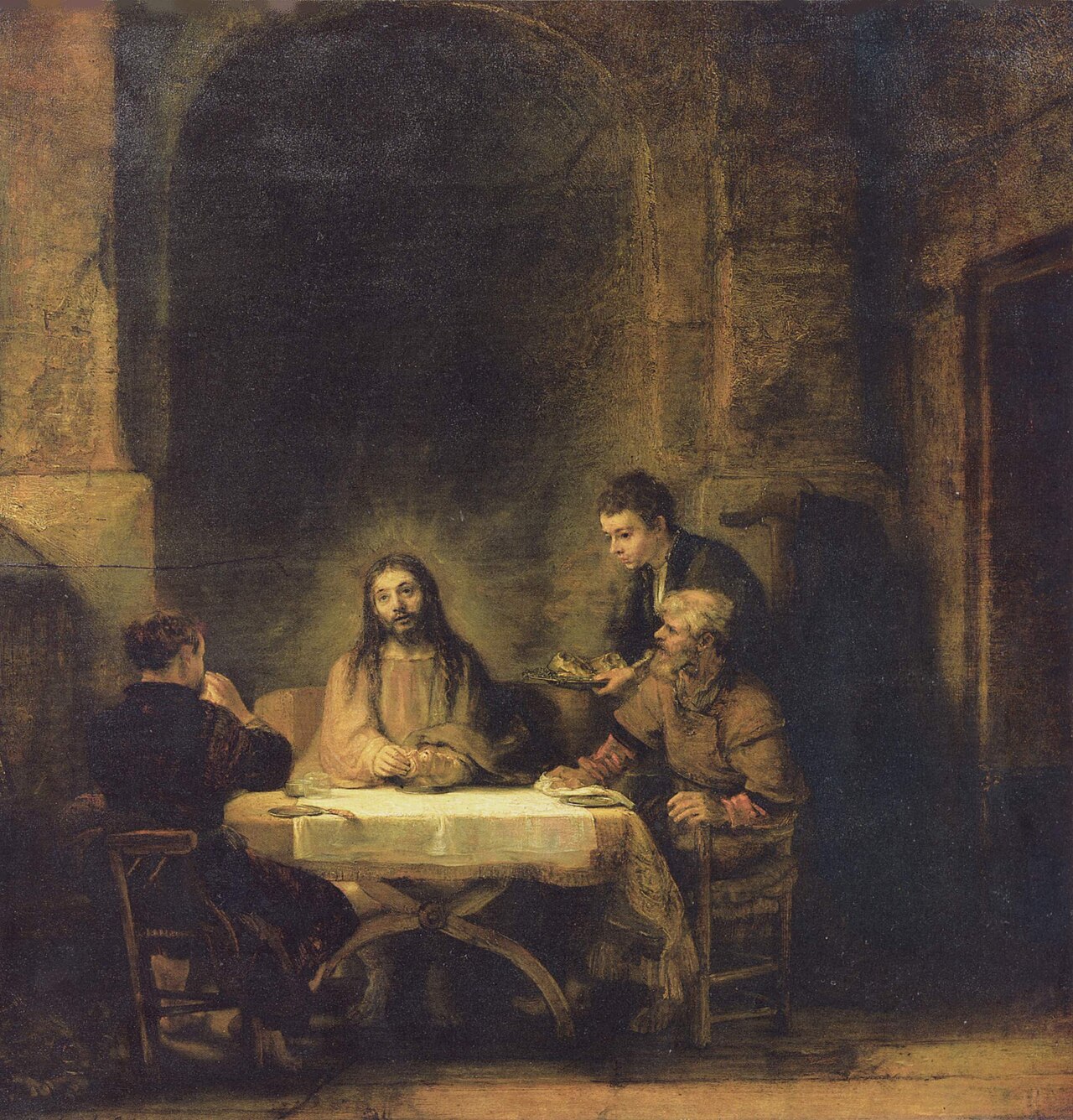
As we gather… “But we had hoped that he was the one to redeem Israel” (Luke 24:21). There is a deep irony as the two disciples on the road to Emmaus lament to Jesus that Jesus failed in His task of redeeming Israel. As the rest of the story goes, Jesus would take the trip to explain Scripture to them to open their hearts to what was prophesized of Him. Likewise, He opened their eyes in the breaking of the bread as they realized it was Jesus the whole time. In life we face disappointments and failures. There are ways which we feel that Jesus has let us down when we face these setbacks. Nonetheless, we continually go to Scripture and His Sacraments to be reminded that it was Jesus the whole time. When we face difficulties, perhaps only in hindsight can we see Jesus walking with us on the road. Through the comfort of God’s Holy Word we can have Easter joy even in a Good Friday world.
Grace, mercy, and peace from God our Father and our Lord and Savior, Jesus Christ.
There are certain patterns throughout Scripture which illustrate the character of our God. Certainly there are many themes and patterns we could discuss, but as we examine our Gospel text today, one theme in particular sticks out, that of teaching over a meal. Today we learn, THE LORD TEACHES HIS PEOPLE AT THE TABLE.
For example, in the Book of Genesis, the Lord visits Abraham and Abraham feeds Him a meal of bread and a calf and the Lord promises Abraham and Sarah that Sarah would have a son, even when she was beyond childbearing years. Let’s look at some more examples.
First, I. The Lord taught Moses and ate a meal with him. Picture the scene, the Lord has freed God’s people from slavery in Egypt. He has fed them manna and quail in the wilderness. He let water miraculously flow from a rock. God’s people make it to Mount Sinai, and Moses ascended the Mount to talk to God. Altogether, the people of Israel spend about a year at Mount Sinai.
God and Moses aren’t talking about something trivial; the Lord is giving Moses His law. Most memorably we can think of the Ten Commandments, but also civil laws such as what to do if someone steals your donkey. The entire kit and kaboodle of all the rules and regulations is known as the law of Moses, or even it can be called the old covenant or old testament. It’s the way that the Lord promised to interact with His people.
After this covenant is established and confirmed, the Lord seals it with a meal. We read in Exodus 24, “Then Moses and Aaron, Nadab, and Abihu, and seventy of the elders of Israel went up, and they saw the God of Israel. There was under his feet as it were a pavement of sapphire stone, like the very heaven for clearness. And he did not lay his hand on the chief men of the people of Israel; they beheld God, and ate and drank.”
What a rare occasion for the people of the Old Testament to behold God. And it’s at a meal! The Lord makes Himself known to Moses and the elders through a meal right after the Lord taught them.
Second, II. The Lord taught His disciples around the dinner table. It wasn’t as dramatic of a scene as Mount Sinai, but many times throughout Jesus’ ministry, He taught the people while eating a meal with them.
Jesus eats dinner at Matthew the tax collector’s house, and He teaches the Pharisees that it’s not the healthy who need a doctor, but the sick. Jesus goes to the house of Simon the Pharisee and a sinful woman washes Jesus which prompts an opportunity to teach us about the power of forgiveness. On yet another occasion, Jesus shocks His dinner host by not washing His hands, and He uses this as a teaching moment to call the Pharisees to repentance.
Each of these meals was special. How could a meal with Jesus not be special? Indeed, we glean many important points of Christian doctrine as we listen to Jesus teaching at those dinner tables.
Nonetheless, these meals were all appetizers for the main course that would define Jesus’ life and ministry. This meal is called the Last Supper or the Lord’s Supper. This meal combined both teaching and eating.
As we look at the Gospels, we see that Jesus taught important things at the Last Supper. In John’s Gospel, John doesn’t record a last supper, but John records five whole chapters of Jesus’ teaching in the upper room. In this teaching He instructs the disciples on the Holy Spirit. He tells them to abide in His love. He comforts them as He anticipates the times of persecution that the disciples will face.
Looking at Matthew, Mark, and Luke, we see this time in the upper room culminates in Jesus’ instituting a new meal. I will re-read these familiar words from Matthew’s Gospel: “Now as they were eating, Jesus took bread, and after blessing it broke it and gave it to the disciples, and said, “Take, eat; this is my body.” And he took a cup, and when he had given thanks he gave it to them, saying, “Drink of it, all of you, for this is my blood of the covenant, which is poured out for many for the forgiveness of sins.”
Unlike the old covenant established by blood and characterized by chapters and chapters of rules and regulations, Jesus establishes a new covenant—a new testament—initiated by His death and sealed by His resurrection. In this meal, the disciples beheld God and ate and drank.
Likewise, III. The Lord taught His disciples after His resurrection at a meal. With all this introduction, we begin to see this pattern of teaching and eating. As we approach the account of the Road to Emmaus, it all begins to make sense.
During Jesus’ ministry, the Pharisees were eating with God, “But their eyes were kept from recognizing him.” They, like the Emmaus disciples, had their own ideas of who the savior should be. They had their own ideas of what it would be like if God walked among them. They couldn’t see what was in front of their own eyes.
It takes some teaching for these two Emmaus disciples to get with the program. We read, “And beginning with Moses and all the Prophets, [Jesus] interpreted to them in all the Scriptures the things concerning himself.” But even then, they still don’t recognize Him.
They invite Him to dinner, and we read, “When he was at table with them, he took the bread and blessed and broke it and gave it to them. And their eyes were opened, and they recognized him. And he vanished from their sight.”
It takes them having a meal with Him before they recognize it is indeed Jesus. When they recount the events to the other disciples, Luke tells us that “[Jesus] was known to them in the breaking of the bread.”
The point is not that they had the Lord’s Supper with Jesus. The point is that teaching and a meal go hand in hand, and there’s something important going on when we sit down to eat with Jesus.
Finally, IV. The Lord teaches us after His Ascension at a meal. So we too gather week after week. Yes, we have weekly Bible studies and those are great. We have fellowship meals occasionally like we did on Palm Sunday. However, the chief thing the Church does that makes the Church the Church is that we gather together to worship.
What we do in worship is modeled after this pattern the Lord Himself has set for us. It is a pattern of teaching and eating. Just as the Lord taught Moses on the Mountain and then ate with Him, just as Jesus taught the disciples and Pharisees and ate with them, just as Jesus took His twelve disciples and gave them a special meal with a special lesson, we too follow this pattern as the Church.
This is why we as a congregation are making the move toward Every Sunday Communion because in the Lord’s Supper we behold Christ, yes for the forgiveness of sins, life, and salvation, but also we encounter the Christ who is our teacher who encounters us on this road of life, and opens our eyes to the ways He is working in our lives.
We will still keep extra services such as Christmas Eve or Advent or Lenten Midweek services as without communion, but for the main chief service of the week on the Lord’s Day, namely, Sunday, we will offer Holy Communion. It doesn’t mean what we were doing before was wrong or sinful, but it gives us additional opportunities to encounter Christ through this meal.
THE LORD TEACHES HIS PEOPLE AT THE TABLE. Our Lord wants to teach us and eat with us. Today, we have the great opportunity to witness the rite of confirmation with Jake who completed new member classes. We met about ten times for a total of ten hours of discussing Scripture and what it teaches as it is contained in Luther’s Small Catechism. What a pleasure it is to have you join us for a meal today, not just any meal—the Lord’s Supper!
If you haven’t yet been taught and confirmed in the Lutheran faith, let’s take time to go through some of the basics together just like I did with Jake. Remember that Jesus took three years with the disciples before He instituted His supper.
If you have been taught and confirmed, join us as we partake of this meal and find the risen Christ in the breaking of the bread even as we have heard Scripture and teaching. Amen!
The peace of God which passes all understanding guard and keep you in the true faith unto life everlasting. Amen.