Sunday, July 19, 2026
Eighth Sunday of Pentecost
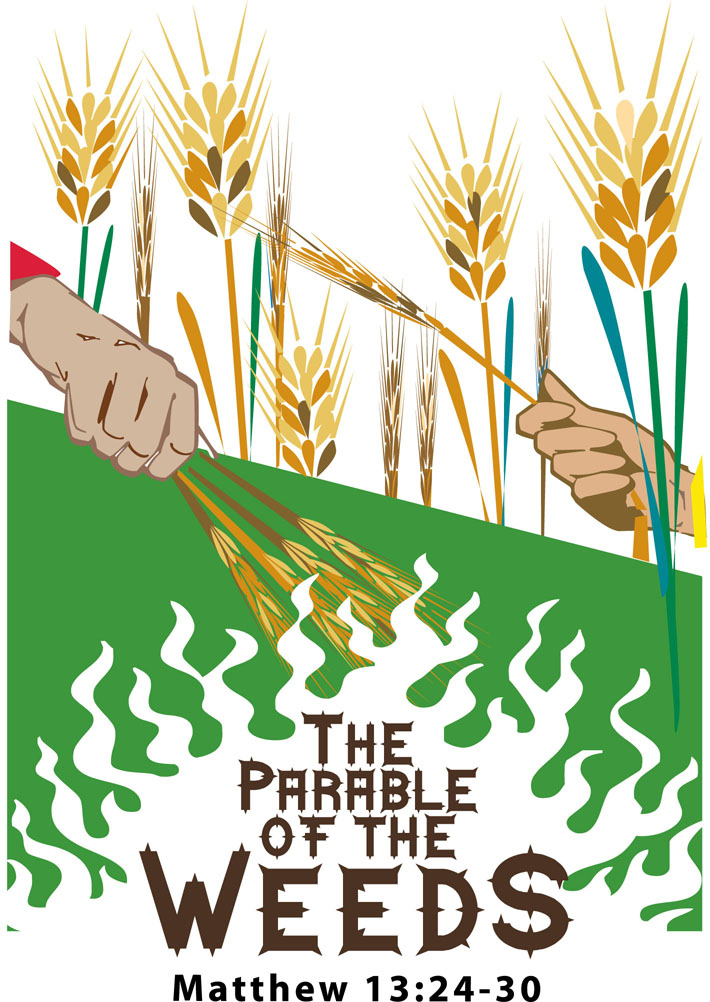
Text: Matthew 13:24-30, 36-43
As we gather… At harvest time I will tell the reapers, Gather the weeds first and bind them in bundles to be burned, but gather the wheat into my barn. – v. 30
Grace, mercy, and peace from God our Father and our Lord and Savior, Jesus Christ.
Lead In – Whether or not you have a green thumb if you can’t get anything else to grow in your garden you will have no problem having a bed full of weeds. With millions of dormant seeds already in the worked-up soil all they need is sunlight and moisture. Most weeds are hearty little buggers. The thorns and thistles, the crabgrass and dandelions, they do not need special care to thrive. And the problem, of course, is that they compete with what you have carefully planted for sunlight, water, and the nutrients of the soil.
- In Contrast to Lesson in the Parable of the Sower
Pulling weeds, roots and all, is normally a part of gardening. They are not to be ignored altogether. Some weeds are more invasive, noxious, and threatening than others. But a weed-free garden is next to impossible and is not necessary. In fact, you can be overzealous trying to eliminate all weeds. You can cause unintended damage to the good plants, and that is the point of our Lord’s parable.
Interestingly, a different point was made about weeds in last Sunday’s Gospel Reading. There we encountered the Parable of the Sower. Without pulling the weeds in that parable the life of the sprouted seed planted by the Sower will be choked and prove unfruitful. The thorns must be dealt with. But in the Parable of the Weeds the point seems to be the opposite. The servants of the farmer are told to let both the wheat and the tares grow together until the harvest time.
So, what gives here? How are these two lessons to be reconciled?
I have two suggestions for how both lessons are valuable and not a contradiction. The first suggestion is what I have just mentioned. One parable has to do with the necessity of pulling some weeds, while the other parable has to with the danger of being overzealous in doing so.
But the second suggestion is to note is the different meaning of the weeds in the two parables. In the Parable of the Sower Jesus has this to say in Matthew 13:22, “As for what was sown among thorns, this is the one who hears the word, but the cares of the world and the deceitfulness of riches choke the word, and it proves unfruitful.” So, the thorns are the cares of the world and the deceitfulness of wealth. If these are not held at bay spiritual fruitfulness will be snuffed out.
In our present parable, the Parable of the Weeds, Jesus informs us that the tares represent the sons of the evil one, the devil. That is, they represent people. As unregenerate, unrepentant sinners, they are under the full sway of the devil.
We do well to remember that baptized believers can unfortunately come under the sway of the devil. That is why our baptismal journey involves a lifetime of ongoing repentance. You will perhaps remember the Apostle Peter? At one moment in Matthew 16 he is commended for making the good confession of the faith. “You are the Christ, the Son of the living God.” And in the next moment in Matthew 16:23 Jesus delivers this stinging rebuke to Peter, “Get behind me, Satan! You are a hindrance to me. For you are not setting your mind on the things of God, but on the things of man.” So, the divide between the wheat and the tares is not always so obvious or consistent.
- Learning Kingdom Truths by Way of Analogy
This is a good point to say something about our Lord’s parables. These impactful short stories are memorable. They can be among the most popular and influential of Jesus’ teaching. At other times they confront and challenge and are not so well received. They illustrate certain kingdom truths and reveal the nature of spiritual mysteries. They do so by way of analogy. “The Kingdom of heaven may be compared to,” or “the Kingdom of heaven is like…” The comparison is not exact. But it is helpful and interesting.
Parables can be pushed too far. They can be milked beyond what they intend to teach, guide, or reveal. They are not the same as, but similar to…
When someone says He eats like a pig, we don’t imagine this means he gets down on all fours and eats off the floor. We understand that the person who eats like a pig eats too much and perhaps in an unseemly manner. Don’t ask me how I would know about this! I just do.
Fortunate for us, just as with the Parable of the Sower, Jesus once again explains the meaning and representations in the Parable of the Weeds. We will briefly look at them.
The man who plants good seed in his field is the Son of Man, our Lord Jesus Christ. His field is the world in this present age. The good seed is the children of the kingdom. These are repentant sinners who in Baptism have been adopted into the family of God as sons of our heavenly Father.
The weeds are the sons of the evil one, the devil. These are unrepentant sinners under the full sway of the devil. The scoundrel who under the cover of darkness surreptitiously planted them in the field is the devil.
The harvest at the close of the age refers to what we confess every Sunday in the Creed, “And He will come again with glory to judge both the living and the dead, whose kingdom will have no end.” And the reapers who will assist the Lord in separating the tares from the wheat are the angels. This task has not been given to us!
It is on the Day of Judgment, and not before, that the separation will take place, and the weeds are to be bundled and thrown into the fiery furnace, not by us but by the angels. Then the righteous will be left to shine in the sun in the kingdom of their Father. And we are righteous, that is, having right standing with God, because of what our Lord Jesus Christ accomplished in dying for our sins and rising bodily on the third day thereafter. Our sins are forgiven. And we are clothed with Christ’s righteousness.
- Two Important Truths Stand Out in the Parable
Before I close with two important truths taught and revealed in this parable, it is worthwhile to tell you about a certain weed common in wheat fields, especially back in the ancient world. It is called Bearded Darnel. This weed is especially pernicious in that when it sprouts it looks very much like a wheat plant early on. It is only in the latter stage of development, when the heads of grain on the wheat stalk bend that the two plants are easily distinguishable.
The special problem with Bearded Darnel is its extensive roots that intertwine with the roots of wheat. It is hard to uproot the weed without displacing the roots of the wheat. But the separation finally needs to happen as the kernel from the Darnel is toxic and if mixed with the flour it can cause a severe illness when consumed.
The first truth that stands out to me in this parable is the importance of knowing that we have an enemy. The Scriptures clearly identify this enemy. He is variously known as Satan, the devil, the evil one, the serpent, the dragon, and other such titles. Two Scriptures especially spell out this threat. The first is 1 Peter 5:8. “Be sober-minded; be watchful. Your adversary the devil prowls around like a roaring lion, seeking someone to devour.” The second is Ephesians 6:12. “For we do not wrestle against flesh and blood, but against the rulers, against the authorities, against the cosmic powers over this present darkness, against the spiritual forces of evil in the heavenly places.”
Knowing we have such an enemy is important. And when we realize that apart from Christ we are no match for our adversary we will remember and pray with more earnestness the Sixth and Seventh Petitions of the Lord’s Prayer. “And lead us not into temptation, but deliver us from evil.”
Scripture would also have us be aware of the tactics of the devil. The devil deals in subtleties and half-truths. In other words, he is a liar. He is full of promises, but they are conditioned on things forbidden us by God’s commandments. Furthermore, they are all empty promises, but they may not seem so at the time. He is good at providing temporary thrills. Forbidden fruit tastes sweet, but it quickly goes sour in the belly. He questions our identity in Christ. Are you really a child of God? Look at you, do you think God can forgive you and claim you as His own? He distracts. He covers our ears from hearing God’s Word. And He mutes our mouths from speaking words of thanksgiving and praise to God.
God’s Word informs us that we have this enemy and what we can expect from him. But it does not tells us everything our curious minds would like to know about the devil. In fact, we are not to be preoccupied with the devil. Instead, according to Colossians 3:2 we are to “Set your minds on things that are above, not on things that are on earth.” Be aware that we have an enemy. But keep your eyes on Jesus.
It is not sane to ignore bad news. But spend even more time with good news. You know how the good news/bad news works out? You’ve heard the humor…
Here’s Good News/Bad News humor directed at a Pastor. I will share two. The Good News: The Elder Board accepted the Pastor’s job description of his office the way he wrote it. The Bad News: They were so inspired by it, they also formed a search committee to find someone capable of filling the position.
One more. The Good News: Church attendance rose dramatically the last three weeks. The Bad News: The Pastor was on vacation.
Friends, the Bible would not have us skip the bad news. But the overall Good News of God’s Word is His plan to rescue and redeem the world of lost sinners. He has overcome the enemy and He is able to guard and protect His own until the devil is consigned to the fiery pit forever.
The second truth expressed in the Parable of the Weeds is that it is not our job to try to make things pure in the world of this age. This includes the expression of the church in this age. St. Augustine famously applied the Parable of the Weeds in the fourth century to combat a rigid sect known as the Donatists who demanded a pure church and wanted to expel members from the church who had compromised their faith.
What we want to keep in mind is that there are extreme cases that demand discipline. The Apostle Paul warns in 1 Corinthians 5:6, “Do you not know that a little leaven leavens the whole lump?” In the Corinthians Church there was a individual involved in a scandalous expression of sexual immorality. He was unrepentant. And the Apostle Paul insisted that this individual needed to be barred from the fellowship until such time as he repented. But this was an extreme case.
And in society in general God also ordains Governing authorities to bear the sword. They are to be a terror to bad conduct. They are the servant of God to carry out God’s wrath on the wrong doer. So, these are a couple examples of not ignoring the weeds altogether. But watch out for misplaced zeal in rooting out all evil. It can quickly do more harm than good.
And Now for a Final Word – With news 24/7 we are acutely aware of all the evil shenanigans in the world. Is this good for us? I think we all know it isn’t the least bit healthy. Unfortunately, the bad news is not confined to society in general but is true of the Church in this age as well. This can be especially discouraging! Where is the perfect society? Where is the perfect church? Well, according to our Lord, you won’t find it in this age. Evil will persist until the Lord’s return. Meanwhile, Jesus encourages us with these words in John 16:33, “I have said these things to you, that in me you may have peace. In the world you will have tribulation. But take heart; I have overcome the world.” Friends, the weeds are destined for the fiery furnace. And redeemed sinners can look forward to shining like the sun in the kingdom of our Father. Amen.
The peace of God which passes all understanding guard and keep you in the true faith unto life everlasting. Amen.