Sunday, September 13, 2026
Sixteenth Sunday of Pentecost
Text: Matthew 18:21-35
So also my heavenly Father will do to every one of you, if you do not forgive your brother from your heart.”– Mt 18:35
Grace, mercy, and peace from God our Father and our Lord and Savior, Jesus Christ.
Lead In – Forgiving others who sin against us is not optional for baptized believers. It is the expectation. Even more, it is mandated by our Lord. We are taught to pray in the Fifth Petition of the Lord’s Prayer “Forgive us our trespasses as we forgive those who trespass against us.” But forgiving others who have sinned against us is not an easy task! It requires the help of God who dearly wants His mercy and the fruits of His Son’s cross to be received by all.
- Two Truths Derived from Scripture to Keep in Mind
There are two truths derived from Scripture to keep in mind when we go about our Baptismal Vocations in serving Christ our Lord, especially in the matter of forgiving others when they by sinning offend us. And that first truth is that God’s mercy is intended for all the world. For each and every human being. And this truth is expressed in many places in the Bible, but I will share three of my favorite passages that profoundly express this.
First from 1 Timothy 2:3-4, which reads, “[supplications, prayers, intercessions and thanksgivings made for all people] is good, and it is pleasing in the sight of God our Savior, who desires all people to be saved and to come to the knowledge of the truth.”
The second is from 2 Peter 3:9, and this concerns the return of Christ on the Day of Judgment, “The Lord is not slow to fulfill his promise as some count slowness, but is patient toward you, not wishing that any should perish, but that all should reach repentance.”
And a final passage is taken from the Book of the Old Testament Prophet, Ezekiel, 33:11, “As I live, declares the Lord God, I have no pleasure in the death of the wicked, but that the wicked turn from his way and live; turn back, turn back from your evil ways, for why will you die, O house of Israel?”
These passages should be of immense comfort to each one of us individually. Why? Even though I might wish for my enemies to suffer God’s wrath, I certainly don’t want to suffer it myself. But how can I be certain that God intends me to be spared His wrath, the wrath that I unquestionably deserve? Because God has made it abundantly and unmistakably clear that He wishes no one the full punishment that they deserve. I’m included in the “all” that He wishes to show mercy to. And so are each one of you!
And the second truth is this. God’s storehouse of blessings and gifts are unlimited. We are not talking about a zero-sum game. Do you know what is meant by a zero-sum game? It’s the idea that one person’s gain necessarily corresponds to another person’s loss. Some things in this life might work that way. We encounter lots of limitations in this world. But God is not like that. The Apostle Paul expresses it this way in Ephesians 3:20-21, “Now to him who is able to do far more abundantly than all that we ask or think, according to the power at work within us, to him be glory in the church and in Christ Jesus throughout all generations, forever and ever. Amen.”
A couple of examples from Scripture come to mind concerning God’s unlimited supply. You will perhaps remember the widow at Zarephath in 1 Kings 17. She was down to her last meal for her and her son when she shared her food with Elijah the prophet. For her honoring a prophet of God a miracle took place with her meager store of flour and oil. As she drew each day from this store, the jar of flour and jar of oil was never depleted. Which reminds me of the multiplication of food we read about in Matthew 14 six weeks ago. Do you remember the feeding of the 5,000 with just five loaves of bread and two fish? And how the leftovers after the feeding filled twelve baskets!
Friends, our neighbor’s experience of mercy does not diminish the amount of mercy God can show me. And we who have already been shown mercy, will not have that mercy detracted from our account in order for our neighbor to receive the same. In fact, in giving the gift of mercy, our own store is replenished, refreshed, and kept lively, rather than to grow stale or wither away.
- Joseph’s Story Takes Up Nearly a Third of Genesis
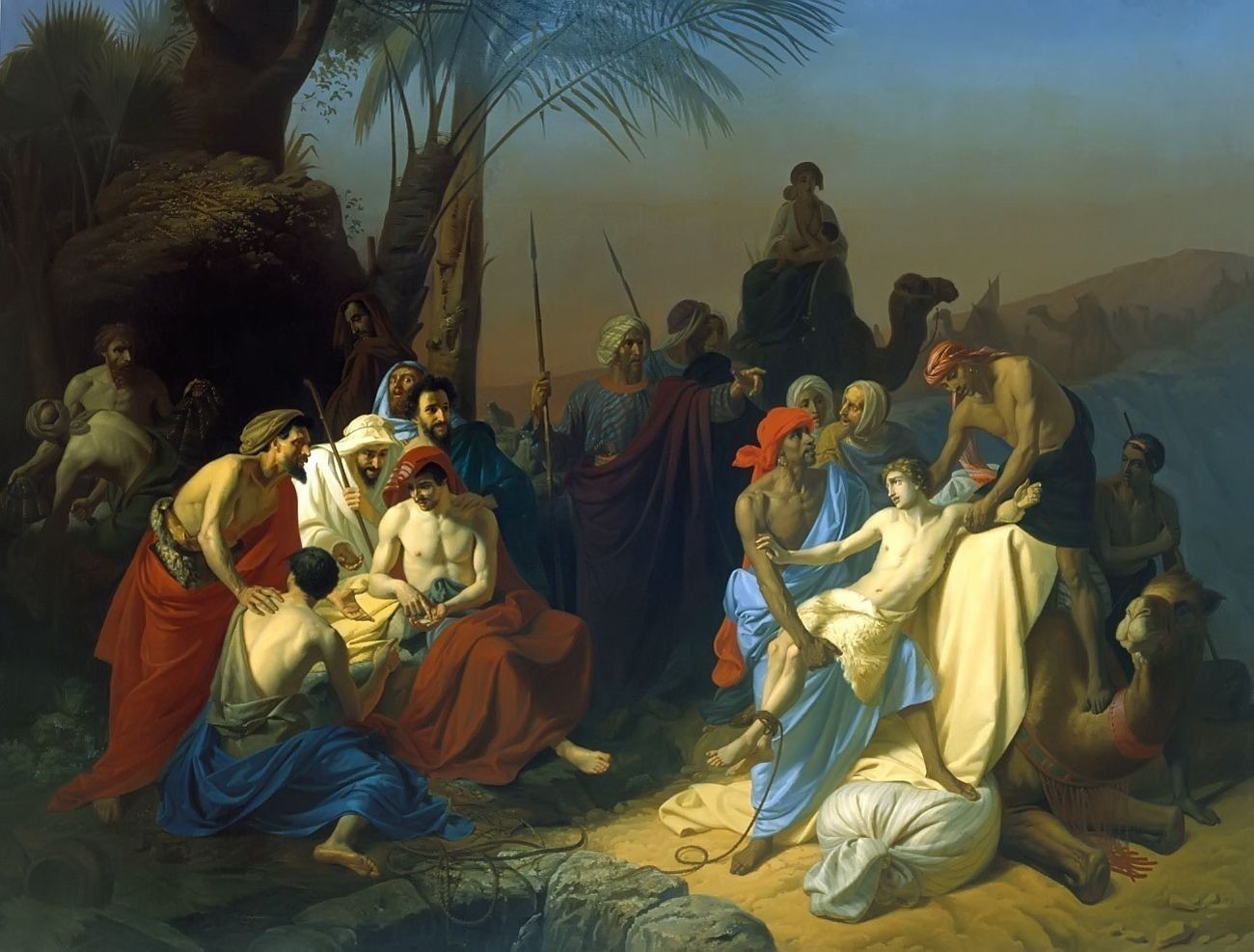
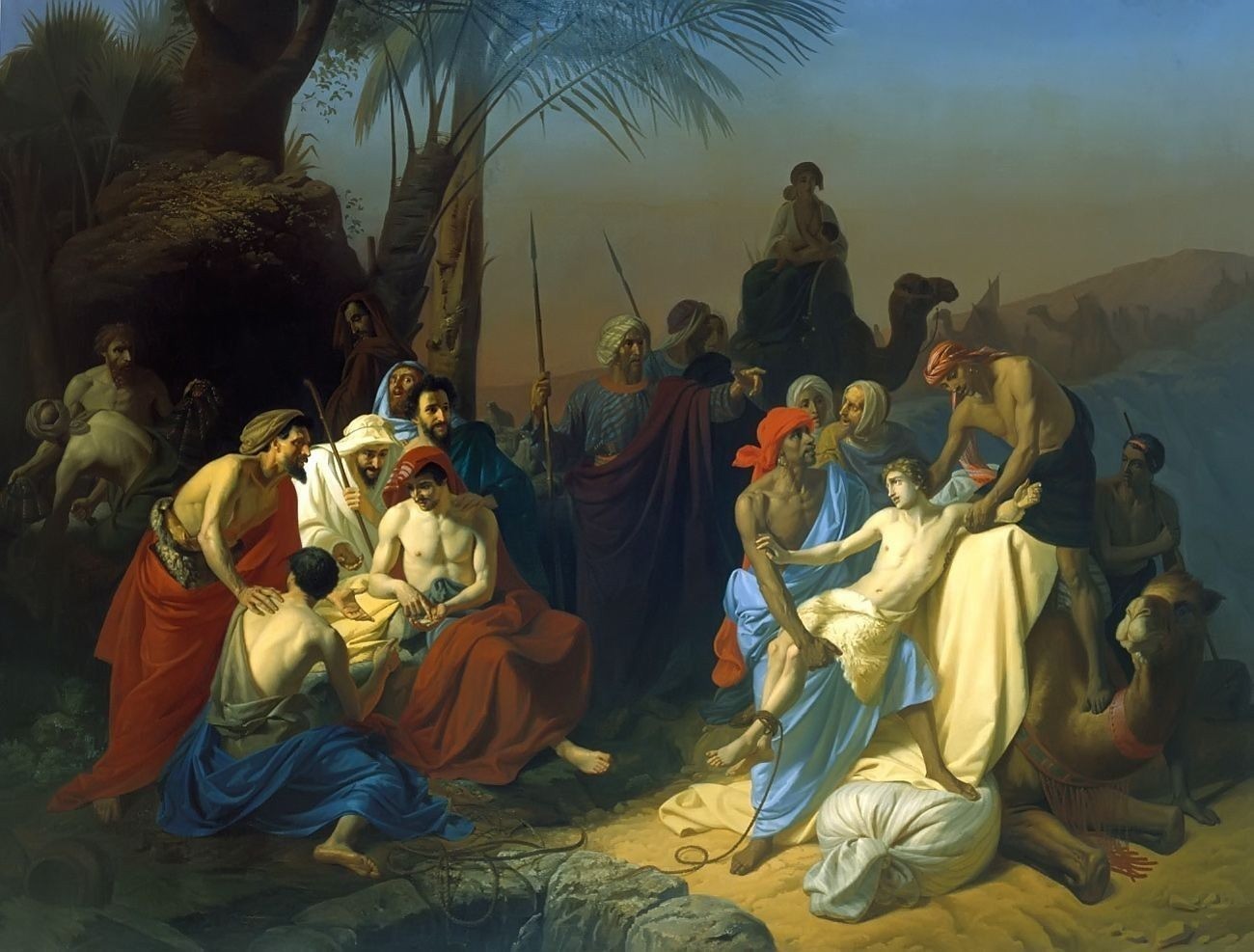
Our Old Testament Reading provides one of the greatest case studies of forgiveness imaginable. Joseph, one of the Twelve Sons of Jacob, also known as Israel, exemplifies what it means to show forgiveness to those who sinned and intended harm against him. And Joseph’s story comprises nearly a third of the Book of Genesis. I will necessarily need to be brief in recalling the narrative.
Joseph was the eleventh oldest of twelve sons. His older brothers did not like him. And truth be told, they had cause for despising him, both by the way Joseph spoke and acted, and by the fact that he was clearly favored by his father. But that hardly excused the dastardly sins they committed against him. They sold him into slavery, lied to their father about Joseph’s disappearance concocting a story with fake evidence that Joseph had been ravaged and killed by some animal. This brought incredible grief to Jacob.
Joseph’s time in Egypt is as colorful a story as you could imagine. Suffice it to say there were a lot of ups and downs. Who could have imagined the role God was grooming Joseph to play!
Joseph served as a household slave before, falsely accused, he served time in an Egyptian prison. He was 17 years old when he was sold into slavery. And he was 30 years old when he was released from prison because he could interpret Pharoah’s dreams and demonstrate the wisdom whereby, he was put in administrative charge of all of Egypt, being second in command to Pharoah only.
Through all of Joseph’s hardships he grew in his trust of God and the gifts the Lord had given him to be a great leader. This included learning humility and learning to trust in God’s providential care. So, when he was elevated to arguably one of the most powerful positions of the day, Joseph was in a unique position to manage a great famine that lasted in the Mideast for seven years. It was this severe famine that brought Jospeh’s bothers down to Egypt to buy grain.
Time does not permit the retelling of one the great stories, not only of the Bible, but of all time. You could start with the 29th chapter of Genesis and read through to chapter 50, the end of the Book, to read it in all its details. The narrative has been picked up in modern plays. And with the recent passing of Dolly Parton, many of you will recall her hit song, “Coat of Many Colors”, which drew lessons from the Joseph story.
For our purposes, suffice it to know that the high official in Egypt that Joseph’s older brothers encountered was none less that Joseph himself, but quite unrecognized by them, especially as they thought him to be either long dead or lost to obscurity. When Joseph finally revealed himself to his brothers, which revealing is a story in itself, the brothers, full of guilt, thought retribution was going to come raining down on them. But they experienced forgiveness and reconciliation instead. The reconciliation came about, first, because Joseph was forgiving, and second, because the brothers owned up to their sins and were repentant.
In the Old Testament Reading this morning Joseph’s brothers fear that now that their father Jacob had died, Joseph would exact revenge on them. But Joseph reassures them that he indeed forgives them. And as for how and why he was able to overlook such grievous offenses had to do with his faith in God. We read this in Genesis 50:20, “But Joseph said to them, ‘Do not fear, for am I in the place of God? As for you, you meant evil against me, but God meant it for good, to bring it about that many people should be kept alive, as they are today.’”
- Important Truths to Help Us to Forgive Others
Brothers and sisters in Christ, with the time that remains I wish to share three things to help you in the all-important task of forgiving others, the task that requires divine help for us to stand a chance.
First, realize that forgiveness is more than a feeling. When we have been, or are being, injured by another, we certainly are not going to feel good about that person! At bare minimum we will be defensive. And more than likely we will want to retaliate, to strike back. Rather than waiting around for the right feeling, we can make a determined effort to do what God expects of us. Let go of the desire for vengeance. Romans 12:19 reads, “Beloved, never avenge yourselves, but leave it to the wrath of God, for it is written, ‘Vengeance is mine, I will repay, says the Lord.’”
I heard a dear sweet lady, Corrie ten Boom by name and now of blessed memory, liken our feelings of vengeance towards those who offend and injure us as a giant bell tolling, the kind that a continual pull on the rope is required for it to ring. Once there is a good swing, the bell will continue to toll for a while until it loses its momentum. The first act of forgiving is to quit pulling on the rope. Let go. The momentum will begin to dissipate.
Second, it is important to know that forgiveness does not automatically result in reconciliation. Reconciliation is certainly the goal of forgiveness. It is required for it to take place. But relationships are a two-way street. We are expected to forgive whether the offender is repentant or not. But a restored relationship can only take place if the offender is repentant. If the offender keeps attacking you, there is no peace! Just a willingness on your part, by the grace of God, to forgive and live at peace.
Finally, third, forgiveness does not necessarily erase all the consequences of sin. Divine forgiveness takes away the ultimate consequence, eternal damnation. Forgiveness makes reconciliation possible. The Lord truly forgave King David when he repented of adultery and murder, and yet there were certain things David suffered in this life because of his actions. When we think of it, our physical death is a consequence of sin, even though by God’s grace we will share in a resurrection like Christ’s, and will be spared the final judgment. But without sin none of us would have ever died, even a physical death. Temporal consequences are baked into the cake. They can even be used by God to bring us to repentance.
And Now for a Final Word – The English poet, Alexander Pope, in a line in his poem “An Essay on Criticism” famously said “to err is human, to forgive, divine.” How true. And yet, it is expected of humans who are joined to Christ and thereby forgiven an incalculable debt, that they extend this gift of grace to others. The failure to do so is tantamount to ingratitude and a rejection of the mercy and forgiveness so freely offered to us in the first place. And so, we continue every day to pray, “Forgive us our trespasses as we forgive those who trespass against us.” And remember, God is dead serious about the matter. Our lesson this morning could not make it any clearer. Amen
The peace of God which passes all understanding guard and keep you in the true faith unto life everlasting. Amen.