Sunday, October 25, 2026
Reformation Day (observed)
Text: Revelation 14:16-17
Then I saw another angel flying directly overhead, with an eternal gospel to proclaim to those who dwell on earth, to every nation and tribe and language and people. – Re 14:6
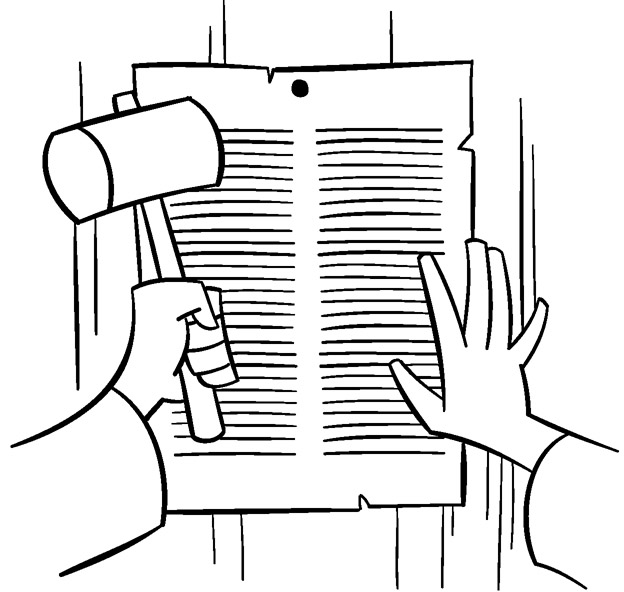
Lead In – The massive wooden door of the Castle Church in Wittenberg, Germany, has long since vanished. In Martin Luther’s day, it served as a simple university bulletin board—the very surface where he posted his historic 95 Theses on October 31, 1517. Today, visitors encounter an imposing bronze door, its surface raised with the letters of those original arguments, a material that prevents the striking of a nail. While this historic door has succumbed to the inevitable changes of time, the truths once affixed to it remain untouched. The door itself has changed, but the message has not: for truly, the Word of God endures forever.
- The Challenges of the Church in the Late Middle Ages
By the late Middle Ages, the churches of Europe had become encrusted with layers of human traditions, trappings, and complex pieties that buried and obscured the eternal gospel of our Lord Jesus. The focal point of faith, which is God reaching down to humanity in His mercy, was increasingly eclipsed by human effort. The spotlight, which belonged solely to the God made visible in His incarnate Son, was instead crowded with the saints, church magistrates, and the self-serving institutional systems.
Particularly controversial was the doctrine of the “Treasury of Merits.” The Church taught that certain exemplary Christians, led by the Virgin Mary and followed by canonical saints and martyrs, had performed more good deeds and endured more suffering than was necessary for their own salvation. This generated a spiritual surplus. And this surplus was held to comprise a heavenly treasury overseen by the Pope. These merits could be drawn upon to reduce the time that believers (or their deceased relatives) spent suffering in purgatory.
By Luther’s time, the system had evolved from requiring genuine acts of devotion (like fasting or a pilgrimage) into a highly commercialized indulgence industry. Church officials, such as the Dominican friar Johann Tetzel, began aggressively selling plenary (full) indulgences (remission of punishment) in Germany. The proceeds were used to pay off regional church debts and fund massive building projects in Rome, including the construction of St. Peter’s Basilica.
Martin Luther found this practice abominable and completely at odds with the witness of Scripture. In his 95 Theses he directly targeted the whole notion of the Treasury of Merits. Luther argued that the system gave people a false and dangerous sense of security. In Thesis 62, he delivered his core counter-argument: “The true treasure of the church is the most holy gospel of the glory and grace of God.” For Luther, Christ’s sacrifice was completely sufficient on its own. Believers are justified by faith alone (sola fide), meaning righteousness could never be bought, sold, traded, or transferred like currency from the surplus account of dead saints.
- Reformation Is Needed in Every Age
Brothers and sisters in Christ, I believe there is an ongoing need for reformation throughout the life of the Church. Distractions, faults, and abuses perennially rear their head. The simple yet profound message central to the Christian Faith needs to be contended for. It is the Gospel, that is, the good news of Jesus Christ’s life, death, and resurrection to save and redeem a fallen world. This proclamation of salvation is entirely a work of divine grace and comes to us as a gift. And the gift is beneficially received by faith alone, in Christ alone, to the glory of God alone. The ongoing work of reformation is often a matter of stripping away layers of human traditions to reveal this bedrock truth. Sometimes such layers are at odds with the truth. And sometimes they merely cover up and hide what needs to stand out.
It is easy to treat the Gospel as nothing more than the entry point to Christianity, a starting line we cross before moving on to deeper or more practical matters. But in our Lutheran tradition, the Gospel of Jesus Christ is the permanent center of our preaching, teaching, and ministry. Vital fruits flow outward from this core, but they can never replace it. When social activism, political alignments, moralism, or growth strategies steal the spotlight, the Church loses her true power and identity. We must remember the golden rule of focus: “The main thing, is to keep the main thing, the main thing.”
It is an ageless human temptation to believe that we must contribute something to our own salvation. We call this inclination ‘works-righteousness’. But Scripture completely shatters this idea. In our Second Reading, Paul writes in Romans 3:20 that “for by works of the law no human being will be justified in his sight, since through the law comes the knowledge of sin.” The truth is, no amount of good behavior can save us. Titus 3:5 drives this home, declaring that ” he saved us, not because of works done by us in righteousness, but according to his own mercy, by the washing of regeneration and renewal of the Holy Spirit.”
When we try to earn our way to heaven, we always end up in one of two traps: pride or despair. Either we water down God’s standards, convince ourselves we’re doing great, and look down on everyone else; or we realize just how short we fall and lose all hope. The law of God is holy, but it gives us zero power to actually obey it. It shows us our deep need for a Savior, but it doesn’t lift a finger to help us. The law is a mirror that accuses us; it is not the rescue boat that saves us.
- Three Challenges Especially Indicative of Our Age
I’ve briefly mentioned some of the challenges to the Reformers in the Late Middle Ages. I’ve also mentioned the ongoing challenge in every age of the ‘works-righteousness’ temptation to cloud out the Gospel. Now I wish to address you on three challenges to the Gospel in our own time and in our own culture.
Our time is marked by a deep skepticism, by pluralism, and expressive individualism. The whole idea of absolute truth is greeted with hostility. It is not uncommon to hear the critique that the Bible is an outdated, historically unreliable, and a culturally regressive text. It is even charged with being bigoted and hateful. The Church’s challenge is to maintain an unwavering trust in the inerrancy, sufficiency, trustworthiness, and authority of Scripture. It is an article of the faith that we are speaking of the Bible as the Word of God! As Christ’s witnesses we need to trust that God’s Word carries inherent, life-changing power. The Bible does not need to be reinvented or sanitized to be relevant. It needs to be heard. It is a performative word that accomplishes what God purposes. We read this in Isaiah 55:11, “so shall my word be that goes out from my mouth; it shall not return to me empty, but it shall accomplish that which I purpose, and shall succeed in the thing for which I sent it.” We also read in Hebrews 4:12, “For the word of God is living and active, sharper than any two-edged sword, piercing to the division of soul and of spirit, of joints and of marrow, and discerning the thoughts and intentions of the heart.”
A second challenge for the Church today is reducing the Gospel message into something smaller, safer, and less transformative than what Scripture demands. The Gospel is not therapeutic self-help, personal prosperity, or a mere ‘fire insurance’ policy for the afterlife that requires no repentance. This is how Jesus put it in Mark 1:15, “The time is fulfilled, and the kingdom of God is at hand; repent and believe in the gospel.” The Biblical Gospel involves allegiance to the lordship of Christ, the cleansing of our sins, and the restoration of all things. It includes calling believers to a life of discipleship, holiness, and sacrificial love.
Accepting the Gospel doesn’t mean you can ignore God’s Law. In fact, in a general sense the full Gospel includes what Lutherans often refer to as both “law and gospel”. Law and gospel work hand in hand. The law shows us our sin, and the gospel shows us our Savior. We don’t look for a Savior if we don’t understand our need of a rescue. And once we have been rescued by the gospel, we begin to have the wherewithal by faith to trust and follow the law, not to earn our salvation, but in gratitude to be about the things we were created for.
And a final challenge I see for us today has to do with the temptation of settling for unity and peace at the cost of truth. Our culture says it values tolerance and coexistence. This creates a mindset that heavily pressures the church to avoid conflict at all costs. But it is a false peace that comes at the price of compromising with Biblical doctrines on such things as marriage and the family, the gospel claim that Jesus is the only path to God, and the belief that Christ will come again at the end of the age to judge the living and the dead. There are many virtues, but they are not all equal. Lesser virtues must serve the higher ones. Truth, along with love and wisdom, are foundational and at the top.
Hear carefully again the words of our Lord Jesus in our Gospel Reading, from John 8:31-32, “If you abide in my word, you are truly my disciples, and you will know the truth, and the truth will set you free.” It is the truth that sets us free! It isn’t peaceful coexistence, although we should certainly try to live peaceable lives. But not at the cost of hiding our light under a basket. Rather, as we are encouraged by Jesus in His Sermon on the Mount in Matthew 5:16 when He says, “In the same way, let your light shine before others, so that they may see your good works and give glory to your Father who is in heaven.”
And Now for a Final Word – The label ‘Lutheran’ was first used as an insult by the opponents of Martin Luther. They accused the reformers of following the teachings of one man rather than the teaching of Scripture. How ironic! For the Reformation was all about faithfulness to the Word of God. When many of the teachings and practices of the day were held against the light of the Bible, they were found wanting. It was not until after the publication of the Book of Concord in 1580 that our tradition wore the slur as a badge of honor and adopted the label ‘Lutheran’. And it would be our conviction that the label means that we are Christians who stand on the truths of Scripture, none more important than that we are saved by God’s grace, received by faith in Christ alone for our salvation. Here we stand! We cannot do otherwise. So help us God. Amen.
The peace of God which passes all understanding guard and keep you in the true faith unto life everlasting. Amen.