
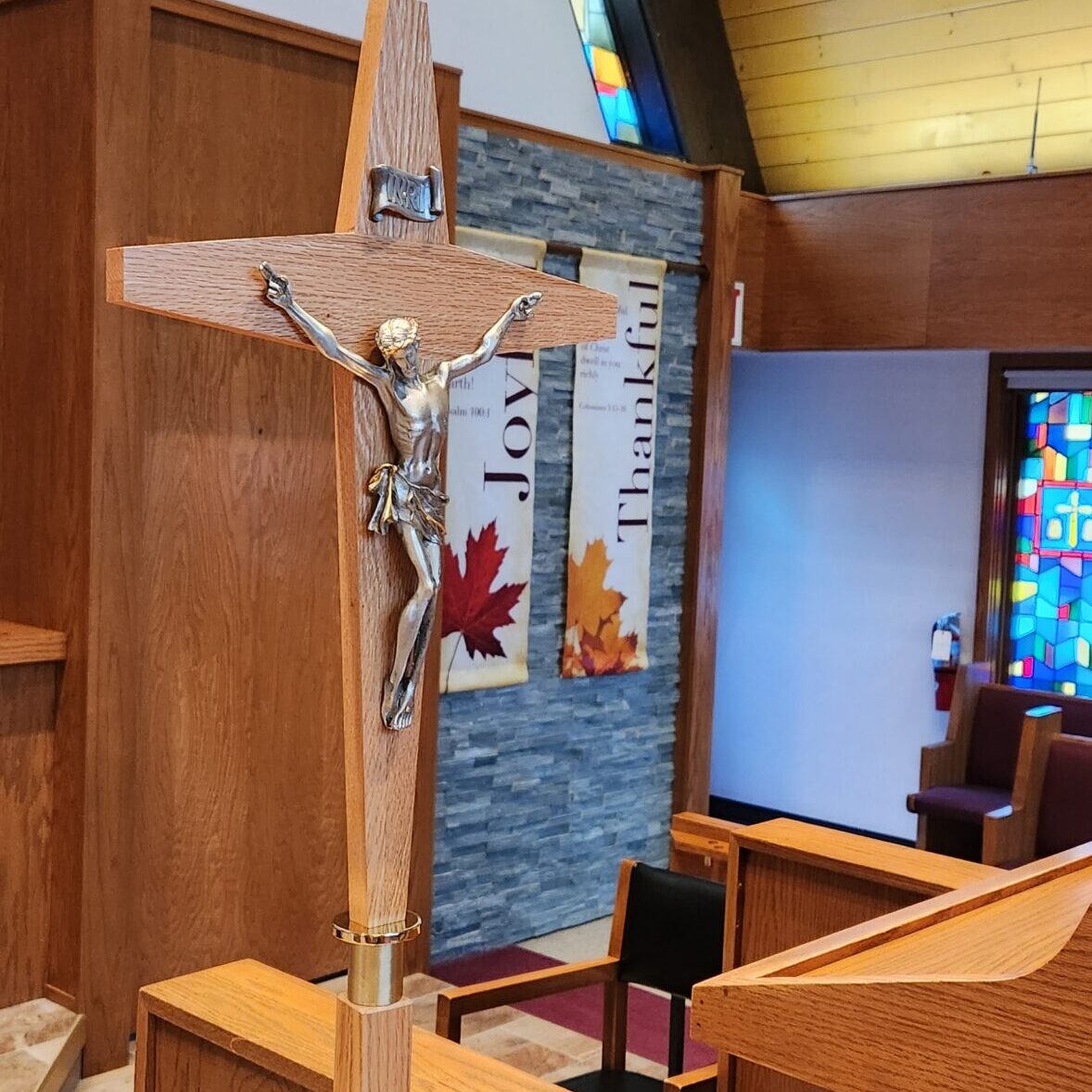
In fall of 2025, Faith received a processional crucifix as a memorial gift. This was a gift that was brought before and approved by both the board of elders and the board of directors. Some have raised the question as to whether the gift of a crucifix is appropriate in a Lutheran Church. The Lutheran Church—Missouri Synod has written saying that crucifixes are appropriate to have in Lutheran Churches.
Pastor Eichers wrote a newsletter article explaining some of the background and rationale for this change. See below:
In addition, in November, Pastor Eichers started publishing bulletin blurbs to help address FAQs about the processional cross. They are being aggregated here:
11/2 What is a crucifix? A crucifix is different than a cross in that it has a corpus, that is, a body, affixed to it. Crucifix literally means fixed to a cross. Paul wrote, “but we preach Christ crucified, a stumbling block to Jews and folly to Gentiles,” (1 Cor 1:23). One of the earliest depictions of Christ crucified was a graffiti made by a pagan in Rome of a donkey being crucified with the caption, “Alexamenos worships his God.” This was made to ridicule the Christian Alexamenos. The earliest record we have of a crucifix is from 590 A.D. made for a queen named Theodelinda. Crucifixes have been an important part of Christian piety and worship for much of the history of the Church.
11/9 How did we get this crucifix? John Jaeger donated this crucifix from memorial funds given in memory of his wife, Karen. This purchase was made with approval from both the Board of Elders and the Board of Directors. The crucifix itself was made from scratch from a workshop in Oklahoma and ordered from Stemper’s catalog which is a church supply store in Milwaukee which now owns Noelke’s downtown. We are thankful for this wonderful gift!
11/16 Shouldn’t the cross be empty because Christ rose from the dead? Christian art uses images and symbols to communicate a deeper reality. If someone likes to keep a manger scene up in her house year-round, it doesn’t mean she believes Jesus never left the manger, but she wants to emphasize the immeasurable gift of God becoming human for us. One misses the point if you look at a picture of Jesus holding a sheep and criticize it saying Jesus never tended literal sheep. A crucifix doesn’t confess that Jesus is stuck on the cross, but it emphasizes a key tenet of our faith, namely, that Jesus suffered for your sins and mine to forgive them. He suffers with us and for us when we face temptation, persecution, and pain.
11/23 Are crucifixes too catholic? For some of you, perhaps this is your first time seeing a crucifix in the front of a Lutheran Church. Isn’t that a thing only for Roman Catholics? First, just because the Roman Catholics do something, doesn’t in itself make it a bad thing. For example, the Roman Catholics also baptize infants. This is an example of a good practice the Lutheran Church has retained. Second, the earliest Lutherans had crucifixes in their sanctuaries. Likewise, the earliest American Lutherans retained this practice of having a crucifix. In our circuit which consists of ten LCMS congregations in La Crosse, Monroe, Juneau, and Adams Counties, 6 of them have a processional or altar crucifix. The crucifix acts as a visual aid to preaching Christ and Him crucified.
11/30 Doesn’t the Bible prohibit graven images? As an addition to the 1st Commandment we read: “You shall not make for yourself a carved image, or any likeness of anything that is in heaven above, or that is in the earth beneath, or that is in the water under the earth. You shall not bow down to them or serve them…” (Exodus 20:4–5a). At face value, it would appear that statues and sculptures would be idolatry. Nonetheless, the Lord commanded the Israelites to make sculptures of cherubim on the Ark of the Covenant and Solomon commissioned sculptures to be made in the Temple. Furthermore, God commanded Moses to create a bronze serpent that if anyone bitten by the snake would look at it, they would be healed. The concern in this commandment is that the people of Israel were not to worship these images. In fact, King Hezekiah destroyed the bronze serpent because the people were doing just that (2 Kings 18:4). In the New Testament, God made Himself into an image (Colossians 1:15). Because we do not worship crucifixes, we are not violating the 1st commandment. Instead, these images direct our minds to the important work Christ has done for us, namely, dying for our sins.
12/7 What did Luther say about crucifixes? “Of this I am certain, that God desires to have his works heard and read, especially the passion of our Lord. But it is impossible for me to hear and bear it in mind without forming mental images of it in my heart. For whether I will or not, when I hear of Christ, an image of a man hanging on a cross takes form in my heart, just as the reflection of my face naturally appears in the water when I look into it. If it is not a sin but good to have the image of Christ in my heart, why should it be a sin to have it in my eyes?” – Martin Luther, Against the Heavenly Prophets, Luther’s Works, American Edition, pages 99–100. . If you want to read more information on crucifixes including more FAQs as they are published in the bulletin, visit faithonmain.com/crucifix.