Sunday, August 2, 2026
Tenth Sunday of Pentecost
Text: Matthew 14:13-21
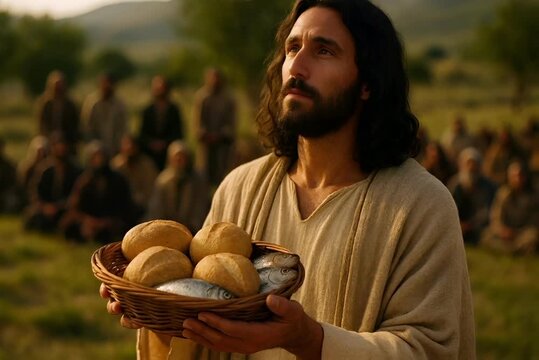
As we gather… And they all ate and were satisfied. And they took up twelve baskets full of the broken pieces left over. – Mt 14:20
Grace, mercy, and peace from God our Father and our Lord and Savior, Jesus Christ.
Lead In – If you enjoy mealtimes and good food several of our readings this morning may whet your appetite. The Gospel Reading recounts Jesus’ miraculous feeding of the 5,000. The first verse of our Psalm Reading is included in the prayer Luther taught in the Small Catechism for returning thanks after a meal. And the Isaiah Reading announces God’s invitation to receive water, wine, milk, and bread that satisfies, and without cost. … Are you ready to dine at the Lord’s table this morning?
- Unsavory Eating and the Food Chain We Were Taught
To begin with I want to say a word about an unsavory image in the Bible about eating. Death was pictured in the Ancient Near East as a big mouth with an appetite that is never satisfied. This is reflected in a number of Old Testament passages. I will cite one example from Isaiah 5:14. The first half of the verse reads, “Therefore Sheol [that is, the place of the dead] has enlarged its appetite and opened its mouth beyond measure.”
This is a gruesome and unappetizing image. Think of the ‘Food Chain’ we learned about in Grade School. For example, when an eagle eats a snake, the raptor is at the top of a food chain, the bottom of which starts with a green plant. That green plant is gnawed upon by a grasshopper. The grasshopper in turn becomes the meal of a frog. The frog is feasted upon by a snake. And then at the top of this particular food chain an eagle eats the snake.
In this age, you might think that humans are at the top of the food chain. With our intelligence we can fashion weapons and tools that can overcome lions, tigers, and bears. But in this fallen age, apart from Christ, death itself is at the top of the food chain. Our bodies will be consumed by the grave. And death is complete with each generation. All are consumed.
The Good News of our salvation in Christ is that it turns out death is not at the top of the food chain. When Jesus rose triumphantly from the tomb on the third day, in the language of Scripture, death was swallowed up!
Listen to these words in Isaiah 25:7-8, “And he will swallow up on this mountain the covering that is cast over all peoples, the veil that is spread over all nations. He will swallow up death forever; and the Lord God will wipe away tears from all faces, and the reproach of his people he will take away from all the earth, for the Lord has spoken.”
That passage was in anticipation of Christ’s death and resurrection. And in 1 Corinthians 15 when the Apostle Paul spoke of the ramifications of Christ’s Resurrection he breaks out in a hymn with these words found in verses 54 and 55, “Death is swallowed up in victory. O death, where is your victory? O death, where is your sting?” Once death is swallowed up in Christ’s victory over it, death is forced to give up what it swallowed. Then all the dead will stand before Christ at the end of the age. And those who are righteous by faith will inherit eternal life in the Kingdom of God.
- Savory Eating in This Age and in The Age to Come
Well, enough of the unsavory aspects of eating. When it comes to our Heavenly Father blessing us with both worldly and heavenly blessings, not infrequently in Scripture this is exemplified as providing a feast or banquet. In our Gospel Reading, with the feeding of the 5,000, our Lord provided physical food to nourish and strengthen the crowd that was famished after following Him to a desolate place. Jesus provided them miraculously with bread and fish. It was a miraculous feeding as He only had five loaves and two fish to start with. But the meager ration was divinely multiplied, and the leftovers were vastly greater than what He had started with.
Of course, food and drink are not the only things we are provided for in this age. When in the Fourth Petition of the Lord’s Prayer we say, “Give us this day our daily bread,” Luther explains ‘daily bread’ this way in the Small Catechism: “Daily bread includes everything that has to do with the support and needs of the body, such as food, drink, clothing, shoes, house, home, land, animals, money, goods, a devout husband or wife, devout children, devout workers, devout and faithful rulers, good government, good weather, peace, health, self-control, good reputation, good friends, faithful neighbors, and the like.”
In our First Reading from Isaiah, we have a picture of the heavenly banquet. This is also richly depicted in Isaiah 25 and in the mention of a Wedding Feast in our Lord’s parables and in the Book of Revelation.
Listen to this description from Isaiah 25:6: “On this mountain the Lord of hosts will make for all peoples a feast of rich food, a feast of well-aged wine, of rich food full of marrow, of aged wine well refined.” I don’t know about you, but I am picturing a juicy, marbled, tender ribeye with a vintage Bordeaux.
The spectacle of this feast implies more than physical food and drink. It indicates a spiritual fare as well. But we need not denigrate physical food. God provides for us both physically and spiritually, both in this present age and in the age to come. Humans were created as both body and soul in God’s good creation before sin entered and wreaked havoc. And when Christ returns at the end of the age, believers will be raised bodily and share in a resurrection like Christ’s. And the the rest of the created order, now beset with futility and corruption, will be restored at His return.
The real distinction of importance is not between the physical and the spiritual, but between this present age and the eternal age to come. And even with that distinction there is an overlapping. The eternal Kingdom of the Father has already broken into this present age with the Incarnate birth of the Son of God to the Virgin Mary and given the name Jesus. We call this Christ’s First Advent. But the fullness and consummation of this Kingdom will not take place until Christ’s Return, or Second Advent. Then this present age will be drawn to a close. But in both ages, you and I will remain a composite of body and soul. And God provides for both. Don’t think of the body as something less. That belongs to other religions, not with the Christian Faith.
- With the Psalmist Be Thankful for His Steadfast Love
The proper response to all this is thanksgiving. And our Psalm Reading does a good job of this. “Give thanks to the Lord, for he is good, for his steadfast love endures forever.” This is the constant refrain in each verse. And what do we have to be thankful for? This list is endless. Even in Psalm 136 we only selected the first nine verses. But in every expression, the love is both steadfast and enduring. Enduring how long? Forever! Every other source we might turn to the so-called love is neither steadfast nor enduring. There is a limit, and a quick one at that. Only our heavenly Father provides endlessly and without limit.
In James 1:17 we read, “Every good gift and every perfect gift is from above, coming down from the Father of lights, with whom there is no variation or shadow due to change.” I pray that God gives us the wisdom to see this. There is only one source of life, love, blessing, and joy!
The steadfast love of the Lord that endures forever has most decidedly and favorably been shown from the Cross of Christ. Everything we receive from God derives from the Cross of Christ! But you might be saying to yourselves, God was providing for the human race long before the advent of Christ and His crucifixion. Yes, but the defeat of Satan and the overcoming of sin and death was already being planned and anticipated on the day Adam and Eve ate the forbidden fruit. We see this, rather mysteriously to be sure, in Genesis 3:15 when God says to the Serpent, “I will put enmity between you and the woman, and between your offspring and her offspring; he shall bruise your head, and you shall bruise his heel.” Suffice it to say, the son born to Mary would deliver the fatal blow to the devil as He Himself is bruised with death on the Cross. Of course, Jesus rose triumphantly from death. Now the devil awaits his final demise in the eternal fire.
It is because of the Cross that we live. Our sins merited death. Adam and Eve, along with all their offspring, died spiritually. We are dead in our trespasses. And yet, we don’t cease to exist. We haven’t received every temporal and eternal consequence of our sin. Because of God’s steadfast love made possible by the Cross we have been given temporal blessings in this age making it possible to also receive eternal blessings in the hereafter. Because of the sacrificial death of Christ our Lord, our lives have been temporarily sustained in this age so that we might come to saving faith in this age. Then in Christ we will have joy forever in the coming age. The Cross of Christ makes every blessing we receive possible.
And Now for a Final Word – When baptized believers gather at the Table of the Lord with repentant hearts, we receive from our Lord Jesus His very body and blood with the bread and wine. We continue to receive the ongoing forgiveness promised to those who are in Christ. We receive bread for the pilgrim’s journey in this age. And, in the words of the Liturgy, we receive a foretaste of the feast to come. How can we not be overjoyed with thanksgiving by this expression of His steadfast love that endures forever. Come, partake of a foretaste of the feast to come. You have been invited to Salvation’s Banquet. Amen.
The peace of God which passes all understanding guard and keep you in the true faith unto life everlasting. Amen.